
What a Bethel Resident Lookup Can Establish
A useful resident lookup is a crosswalk, not one master list. The Bethel Assessor and GIS can tie a name to an owner, mailing line, parcel, or situs address. A court index can show a party and case details. Probate can show a public estate or trust case. Vital indexes can point to an event, while business and license systems show a public filing relationship. Each source has a different date, custodian, and limit, so the first task is to name the question precisely.
| Record route | What it can confirm | Where to search | Access note |
|---|---|---|---|
| Property card | Owner and mailing/situs snapshot | Bethel IAS search | Public; not occupancy proof |
| Parcel layer | Parcel, owner, ZIP, book/page, abutter fields | Bethel GIS | Date the layer and ownership |
| Court index | Party, docket, case type, dates | Judicial Branch inquiry | Protected records may be absent |
| Probate case | Estate/trust case and public fiduciary details | PD-45 case lookup | 2011 to present stated; older data incomplete |
| Vital index | Possible birth, marriage, civil-union, or death lead | Connecticut Genealogy Index | Index only; certificates have rules |
| Business or license filing | Public entity, agent, principal, or credential affiliation | Business.CT.gov and eLicense | Not a private-home record |
Use the property route when an address or parcel is known. Use the court or probate route when a case clue exists. Use a vital index for family history, then request the proper copy from the town or state custodian. When a public affiliation is the question, Business.CT.gov or eLicense is more precise than treating a mailing address as a home. A resident lookup becomes stronger when two independent records point to the same person, place, and time.
Start a Bethel Resident Lookup with Name Variants
Names shift across court captions, deeds, indexes, and old directories. Begin with the form of the name found in the source, then create a small search set rather than changing every field at once. Connecticut court and vital systems offer different matching choices, so a failed exact search does not prove that a record is absent.
- Keep the surname, first name, middle initial, suffix, and any prior surname as separate terms.
- Test a trust, LLC, or business name when the record concerns a fiduciary or public filing, not a private residence.
- Add a Bethel street, parcel, court location, county, or event town when the system allows it.
- Set a date range before broadening spelling. A time window can separate two people with the same name.
- Save the source date and label the result as an index, snapshot, certified record, or lead.
The local two-source rule is simple: one record should supply the identity or location anchor, and a separate source should support the connection. An IAS owner line paired with a court party hit is not enough if the names are common and the dates do not match. Add a deed pointer, a dated filing, a historical address, or an eligible vital record before drawing a conclusion. A person can be a property owner, a court party, a fiduciary, or a business affiliate without being the current occupant of the address.
Bethel Court Party Search Fields
The Connecticut Judicial Branch party search is the main civil name route for Bethel matters through the Danbury Judicial District. The portal also exposes modes for a docket number, an attorney or firm Juris Number, a property address, short calendar, court events, legal notices, and pending foreclosures. A party name is an index lead, not an identity finding. Choose a location and case category when possible, then compare the docket, case type, court location, and dates.
The court-party screen captured for the Bethel research set is shown through the official source below. It makes the search controls clear, while the result grid for an arbitrary personal name was not retained.
Open the official Connecticut Judicial Branch party-search screen to compare the live controls with the fields below.
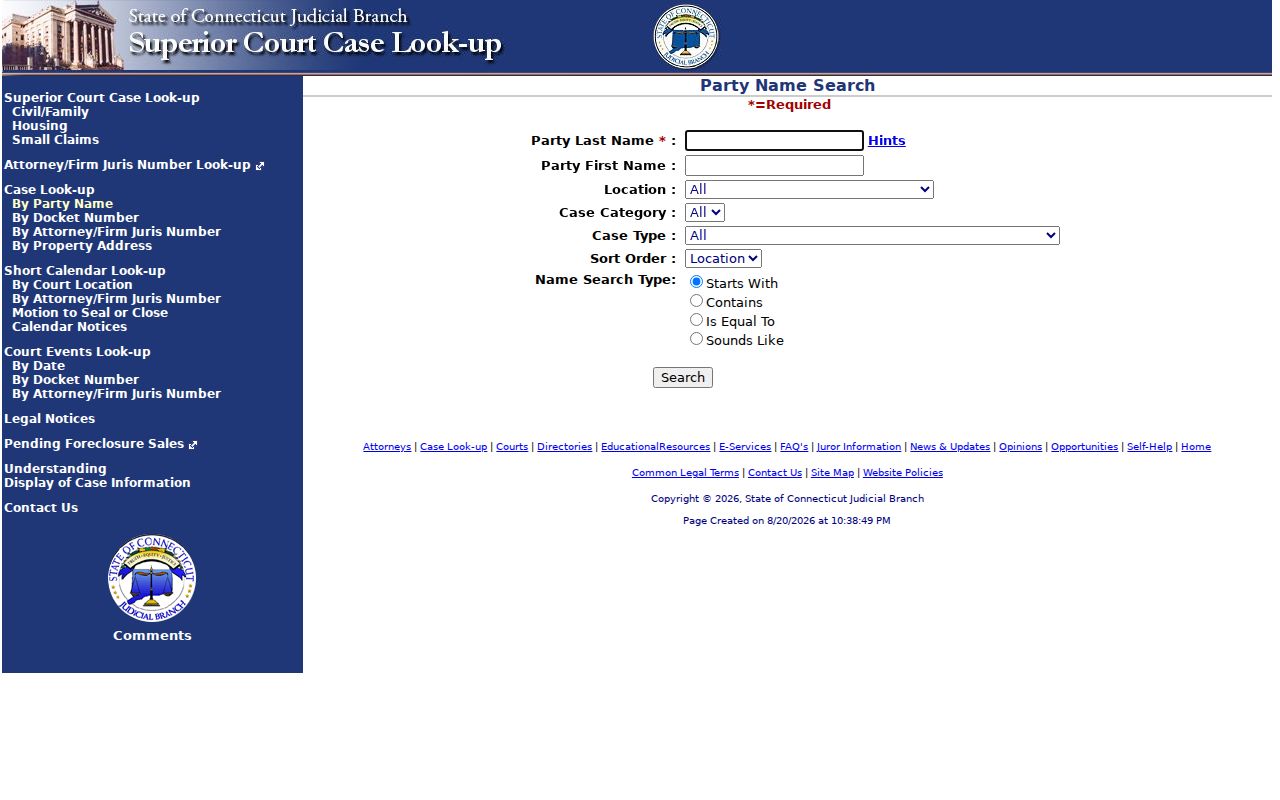
The image records the source screen, not a current case result. Live court pages can change, and protected, sealed, juvenile, or restricted material may be omitted.
| Field or control | Type | Required | Options or format |
|---|---|---|---|
| Party Last Name | Text | Yes | Required surname entry |
| First Name | Text | No | Optional given name |
| Location | Select | No | Use the relevant court location |
| Case Category | Select | No | Narrow the record group |
| Case Type | Select | No | Narrow the matter type |
| Sort Order | Select | No | Choose the displayed order |
| Name Search Type | Radio choice | One choice | Starts With, Contains, Is Equal To, Sounds Like |
| Search | Button | Action | Runs the party query |
Try a distinctive surname with the Bethel-related location or category before using a broad “contains” search. When a result appears, copy the exact docket number and check whether the case is civil, family, small claims, foreclosure, or another category. The Judicial Branch public-access disclaimer says the lookup is a public service, not an official court record, and not a criminal-history report. Ask the clerk about certification or an older file.
Read a Bethel Docket or Property Case
A docket-number search is more exact than a name-only query when a case number is already known. The direct route accepts a location, category, two-digit year, seven-digit number, suffix “S,” or the full docket number. Optional checks can include party information and motions, pleadings, or documents. Preserve the displayed hyphens and suffix so a later clerk request uses the same identifier.
| Judicial Branch route | Fields captured | Important limit |
|---|---|---|
| Docket number | Location; category; year as two digits; seven-digit number; suffix S; full docket number | Use the exact displayed number |
| Docket options | Include Party Info; Include Motions/Pleadings/Documents | Documents may still be restricted |
| Property address | Case Type Foreclosure/Housing; City/Town; Street Address; ZIP; Property Type; Case Status | City/Town is required; ZIP must be a full five-digit value |
| Property filters | City/Town accepts a partial entry of at least three characters; street is optional and partial; Residential, Commercial, or All; Active, Disposed, or All | Not a general list of occupants |
| Coverage | Foreclosure cases on or after 1/1/2014; Housing cases in the listed sessions on or after 1/1/2014 | Some eviction information is removed 30 days after disposition under CGS §47a-26j, effective 7/1/2024 |
A pending foreclosure posting gives a useful sample of what a public result can contain. The Bethel posting inspected on August 20, 2026 showed a 9/12/2026 12:00 PM sale time, raw docket DBDCV256056067S, displayed docket DBD-CV25-6056067-S, a public-auction foreclosure case, and 103 Grassy Plain Street, Bethel, CT 06801.
Sample record inventory. The posting supplies a town, sale date and time, raw and displayed docket numbers, case type, property type, address, caption, file date, return date, posting ID, and notice terms.
- Caption: LAKEVIEW LOAN SERVICING, LLC v. LIN, LIQING Et Al.
- File date: 9/11/2025; return date: 10/7/2025; town: Bethel.
- Posting details: registration instructions, a certified or bank check amount of $51,500, auction terms, as-is language, and possible tax, utility, building, zoning, or easement interests.
That inventory describes a posting, not a completed sale, title change, or current residence. Recheck a live docket or notice before relying on a dated result. The property-address search can identify parties in a case, but it cannot turn a case caption into proof of ownership or occupancy.
Verifying a Bethel Resident Across Records
Verification works best as a short chain. A name enters the system, an address or parcel supplies context, and a separate source tests whether the dates and roles line up. The chain should stay narrow. Collect only the fields needed for the lawful question, and do not copy sensitive identifiers into a working note.
- Set the name. Record the spelling, former surname, middle initial, suffix, and date range that came from the first source.
- Anchor the place. Search the Bethel IAS field-card system or GIS by owner, street, parcel, or address. Keep the mailing address separate from the situs address.
- Test the court record. Run the party search with the narrowest useful category and compare the docket, case location, date, and party role.
- Use an independent record. Check a vital index, probate case, business filing, license credential, or dated historical source that answers the same identity question.
- Request proof when needed. Ask the Town Clerk, DPH, Probate Court, or court clerk for the proper certified copy instead of treating an index screen as the final record.
- Docket
- The court's file identifier for a case. It links the case caption and court activity to a specific matter, but it does not by itself prove a person's address.
- Index versus image
- An index is a finding aid with selected fields. An image is the scanned or official document, which may require an account, payment, or clerk request.
- Certified copy
- A copy issued or certified by the record custodian. It carries a different evidentiary weight from a public search result or an assessor snapshot.
Note: A public index can supply a lead, but a certified copy comes from the custodian and carries a different evidentiary weight.
Bethel Probate and Federal Record Routes
The Connecticut Probate Case Lookup is useful when the person question concerns an estate or trust. Northern Fairfield County Probate Court is District PD-45 and serves Bethel, Newtown, Redding, and Ridgefield. The search fields are Case Type, District, Status, First Name, and Last Name. The public lookup states that decedent-estate and trust data runs from January 5, 2011 to the present; older results may appear but are incomplete. A public case can expose a case number, type, district, and some fiduciary details, while documents can remain restricted.
For a federal matter, use PACER and the District of Connecticut case-information route. An account is required. CM/ECF coverage began in October 2003, while earlier records are at the Federal Records Center. As of August 20, 2026, PACER pricing is $0.10 per page, each document is capped at $3, and quarterly charges of $30 or less are waived. An official notice announced a change to $0.12 per page and a $40 waiver threshold on January 1, 2027. Check the live fee notice before ordering documents.
Probate and federal records help answer a case, estate, or filing question. Neither route is a general current-resident list. Use the clerk for certification, older material, or a restricted-document question.
Bethel Vital Records and the Genealogy Index
Connecticut splits vital-record custody between the Bethel Town Clerk and the Department of Public Health Office of Vital Records. The town handles events occurring in Bethel and qualifying local requests. DPH holds statewide birth, death, marriage, and fetal-death records from July 1, 1897 to the present. For an event before 1897, start with the town where it occurred, then use State Library, newspaper, cemetery, and historical sources.
| Route | Coverage and access |
|---|---|
| Bethel Town Clerk | Town certified birth, death, marriage, and civil-union copies generally cost $20. Use the town form, identity proof, relationship or eligibility details, copy choice, and money order instructions. |
| State DPH | State birth, stillbirth, and fetal-death copies cost $30; state marriage and death copies cost $20. DPH processing can take up to 12 weeks. |
| Birth access | Birth certificates under 100 years are restricted by CGS §7-51. Birth records at least 100 years old become public under the statutory rule. |
| Marriage and death | An adult can generally request a copy, but Social Security number portions have separate limits and may require relationship or identity proof. |
| Connecticut Genealogy Index | Free finding index with no certificate images. Coverage states births 7/1/1897 to 12/31/1917, marriages and deaths from mid-1897 to 12/31/2017, and civil unions October 2005 to October 2015. |
The Genealogy Index accepts optional Given Name and Surname fields, soundalike or close-spelling choices, nickname expansion for given names, a date start and end pair, geographic radius and origin, county, and town or city. A wildcard asterisk can appear at the beginning, middle, or end of a name. Results are divided into births, marriages, civil unions, and deaths, with a top-1,000 limit. Birth and death results can show given name, surname, suffix, date of record, town or city, and county; marriage results show both partners and the event place.
Town and state forms ask for the record subject, event date and place, parent or spouse details where relevant, requester name and contact information, relationship or reason, signature, copy count, and payment. Government photo ID or two approved alternatives are common requirements. A finding-index hit points to a possible record. It does not replace the certificate. For a historical name and address trail, pair the index with the collections described in the Bethel city directory resource.
Bethel FOI Requests When Indexes Stop
Connecticut Freedom of Information Commission guidance is the fallback when an existing Bethel record is not exposed by a search screen. Connecticut's FOI Act, CGS §§1-200 through 1-242, generally allows an oral or written request, although an agency may use its own form. A precise written request should name the custodian, describe the existing record, give a date range, and identify the name, address, parcel, case number, or other key that makes the search workable.
Access must be prompt, not necessarily immediate. The ordinary appeal framework describes a written denial or response within four business days, and the Freedom of Information Commission appeal window is generally 30 days. Municipal paper copies are generally capped at 50 cents per page, subject to exceptions and actual electronic-production costs. Ask for a fee estimate, an electronic format when reasonably available, and segregable nonexempt portions if a record contains protected material.
The guidance image below comes from the official Connecticut FOI source and illustrates the request and appeal route used for a Bethel records question.
Review the official Connecticut FOI request guidance before sending a narrowly framed records request.
A request seeks records that an agency maintains. It does not require an agency to build a new resident list or disclose a portion protected by another statute. If an office cannot produce a requested name list, ask what existing index, report, or file can be reviewed instead.
Bethel Business and License Affiliations
Some resident questions are really affiliation questions. Business.CT.gov searches by business name, ALEI or Business ID, and filing number. Results can show the entity name, ID, principal, agent, formation date, entity type, street address, city, state, ZIP, and annual-report PDFs. Match the Business ID or ALEI rather than relying on a similar name. An agent, principal, or registered address is a filing relationship, not proof that a person lives at that address.
The public Connecticut eLicense lookup covers more than 850 credential types without a login or payment. Its controls include license type, prefix, number, subcategory, status, business or DBA, first name, last name, address, state, city, ZIP, and country. Results can show the credential name and number, type, mailing address, effective and expiration dates, status, and scope or supervisor detail where supported. Check the dates and status rather than reading an inactive credential as a conclusion about conduct.
The Treasurer's Find Your Name route leads to CTBigList for a possible unclaimed-property lead. The exact interactive controls were not exposed in the research session, and a name match still requires claim documentation. Business, license, and unclaimed-property routes are useful for public affiliations or a claim lead. They are weak evidence of a private residence.
Bethel Voter Records and Privacy Filters
The Connecticut Secretary of the State voter lookup is an individual route linked from Bethel's election information. The exact live field labels were not captured because the endpoint rejected automated inspection. The public registry and file rules describe name and former name, address and former address, voting district, party affiliation, and election or primary participation. Month and day of birth, license or ID data, and Social Security number data are not public in the ordinary release; the current public file uses year-only birth information under PA 26-1 §96.
The separate statewide voter-file request is not the same as an individual lookup. The SOTS form requests a CSV, costs $300, and requires certification of a permitted election-related, scholarly, journalistic, political, or governmental use. Personal, private, commercial, advertising, solicitation, marketing, harassment, and resale uses are prohibited. No Bethel ZIP-only resident roll was located. Use the town street guide for district geography, not as a substitute for a person search.
The official voter lookup image below preserves the source route while keeping the absence of captured field labels explicit.
Open the official Connecticut voter lookup and confirm the current controls before relying on a result.
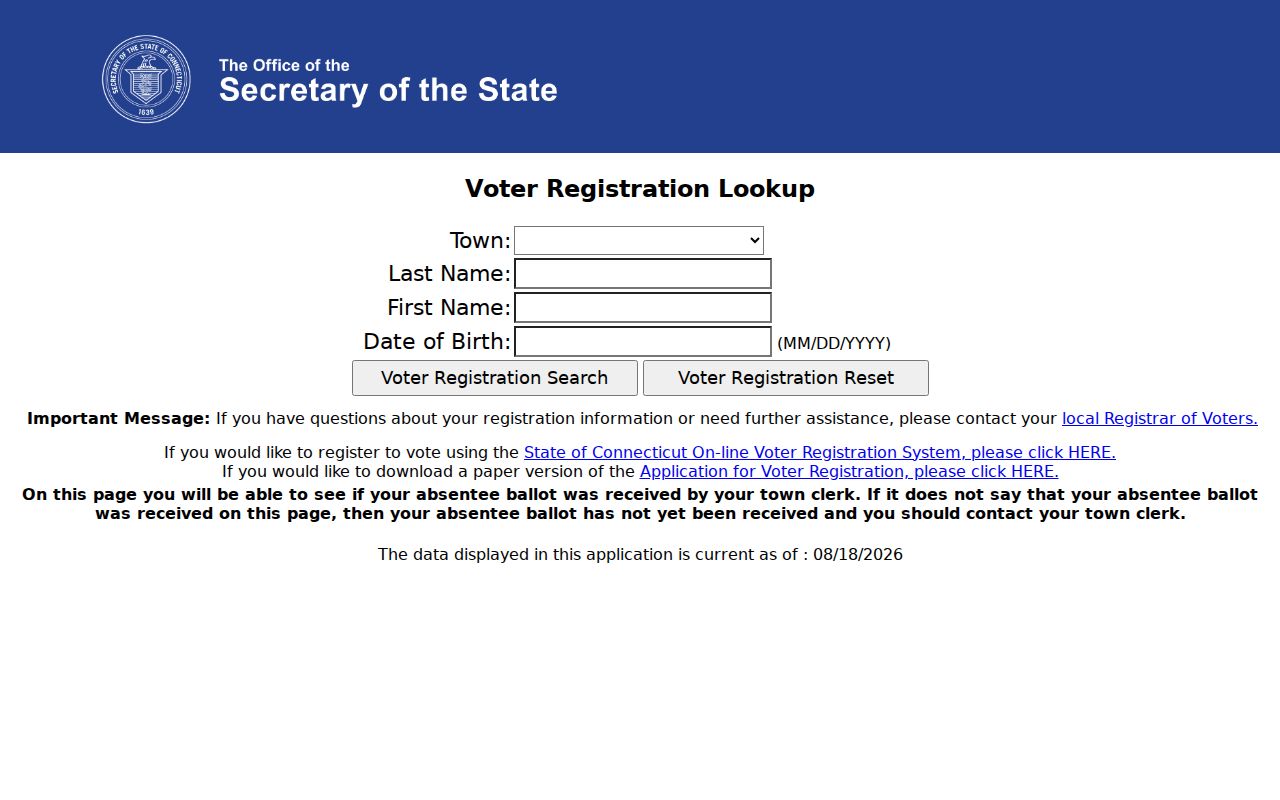
A public voter record can be useful civic context, but privacy programs can intentionally remove a qualifying person's name or address. Treat a missing entry as a limit of the source, not as proof that a person is absent from Bethel.
Legal Limits for a Bethel Resident Lookup
Connecticut privacy rules are record-specific. The Address Confidentiality Program, also called Safe at Home, gives eligible participants a substitute mailing address and limits disclosure of the real address through the program's statutory routes. The Voter Privacy Program uses a sworn safety statement and can suppress name and address from official voter lists. Neither program is a blanket deletion from every deed, grand list, GIS layer, court file, or news item. Never try to reverse a substitute address.
CGS §1-217 covers residential-address nondisclosure for specified protected officials and workers in named records. Birth records under 100 years, adoption records, juvenile or sealed court files, victim and safety information, and active investigative material have separate restrictions. The federal DPPA, 18 USC §§2721 through 2725, limits DMV name, address, license, and identity data. A FOI request cannot override a confidentiality statute.
Lawful use. Use a Bethel resident lookup for personal, lawful research and verify important facts with the custodian. Do not use an address, name, court result, or public affiliation to stalk, harass, threaten, intimidate, or expose another person.
Keep the minimum needed fields, record the source date, and label the evidence level. A certified record, official index, property snapshot, historical transcription, and unverified lead are not interchangeable. Connecticut harassment and stalking laws, including CGS §§53a-181c through 53a-181e and §53a-183, make the safety boundary concrete. If a result is wrong, contact the office that created the record and ask about its correction or certification process.